SCCA2 ELISA
- Reg. Status
- RUO
- Kit Größe
- 12 x 8
- Methode
- ELISA
- Inkubationszeit
- 1 x O/N, 1 x 90 min, 1 x 30 min
- Standardbereich
- 0.0063 - 0.2 ng/mL
- Probe / Vorbehandlung
- 10 µL serum
- Substrat / Isotop
- TMB 450nm
Passende Produkte
weitere ressourcen






This kit utilizes an enzyme-linked immunosorbent assay (ELISA) method to quantify SCCA2 in serum. Samples are added to microtiter plate with 96-wells (solid phase) coated with anti-SCCA antibody, and after washing, a POD-conjugated anti-SCCA2 antibody is added to react, an immune complex is formed. After the unreacted POD-conjugated anti-SCCA2 antibody is removed by washing, a chromogenic substrate is added to perform the enzymatic reaction, and color develops in proportion to the amount of SCCA2 in the samples. The color development is stopped, and the color intensity is measured at 450nm.
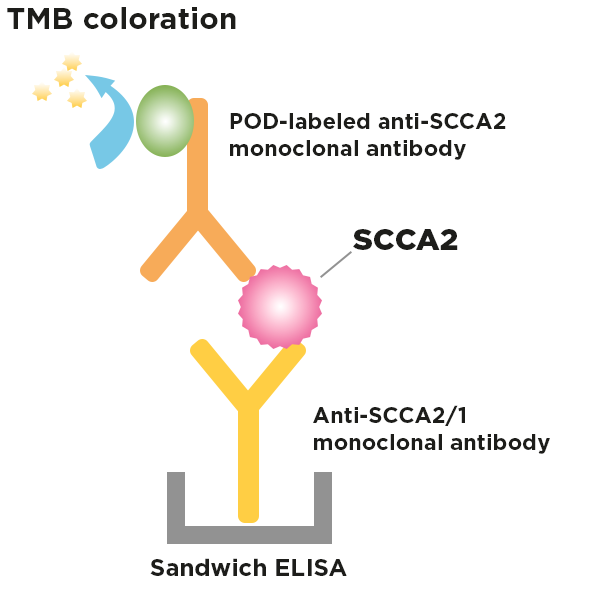
Fig.: Principal of the SCCA2 ELISA
SCCA (squamous cell carcinoma antigen) is a serine protease inhibitor belonging to serpin superfamily, which is a protein with a molecular weight of about 45 kDa produced mainly by epithelial cells. SCCA contains the isoforms SCCA1(SERPIN B3) and SCCA2(SERPIN B4, which are independent gene products transcribed from distinct loci, albeit with very high-amino-acid homologies of 91%.
Unlock deeper insights and improve sample management in dermatology research with the SCCA2 ELISA kit
It is known that interleukin 13 (IL-13), one of the type Th2 cytokines, plays crucial roles in allergic inflammation. SCCA2 was identified as one of the molecules whose expression is elevated when airway epithelial cells are stimulated with IL-4 and IL-13, cytokines that are central in allergic responses.¹ Serum SCCA2 levels in children with atopic dermatitis have been reported to be significantly elevated according to the severity of the disease, even when compared with existing blood tests²,³,⁴.
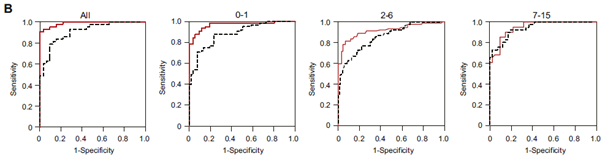
Fig. ROC curve analyses of SCCA2 (red solid line) and TARC (black dashed line) in all and <1 year old, 2 to 6 years old, and 7 to 15 years old of control subjects and AD children
In the treatment of atopic dermatitis, it is important to select and use anti-inflammatory drugs appropriately according to their severity. Currently there are more than 30 different drug candidates in clinical phase 2 and 3 trials⁵ needing reliable objective tools such as the SCCA2 ELISA for stratification of study participants and to see possible effects.
Learn more about how SCCA2 could move the understanding of atopic dermatitis from subjective to objective assessment by watching the video linked below.
Distributed by TECAN, IBL International GmbH
Für konkrete Daten konsultieren Sie bitte die Arbeitsanweisung in der Download Box oben auf der rechten Seite.
Zu unserem umfassenden Angebot an Immunassays gehören eine Reihe spezialisierter diagnostischer Immunassays für die Endokrinologie, Immunologie und zur Untersuchung von Autoimmunkrankheiten, sowie zur Diagnose von zahlreichen Infektionskrankheiten. Wir sind Pioniere und Marktführer in der Speicheldiagnostik, und bieten seit über 40 Jahren ein breites Portfolio an Lumineszenz- und ELISA-basierten Tests.
Als Experten im Bereich Laborautomation unterstützen wir unsere Kunden mit Protokollen für offene ELISA-Plattformen wie dem Freedom EVOlyzer oder dem Thunderbolt®.
Sämtliche Produkte sind nur für den Verkauf an Laborpersonal verfügbar und möglicherweise nicht in allen Ländern erhältlich. Bitte lesen und befolgen Sie immer die Arbeitsanleitung. Kontaktieren Sie uns gerne für weitere Informationen.
Design und Herstellung aller unserer Assays erfüllen die höchsten Anforderungen globaler Richtlinien und Qualitätsstandards. Tecan ist unter ISO 9001:2015, ISO 13485:2016 zertifiziert und gemäß Medical Device Single Audit Program (MDSAP) von einer Benannten Stelle auditiert.

Als Teil der Tecan-Gruppe haben wir eine führende Marktposition in Diagnostik und Forschung. Wir verfügen über 40 Jahre Erfahrung in der Entwicklung, Herstellung und Bereitstellung von Immunassays auf Basis von Enzymreaktionen, Radiomarkierungen und Lumineszenz.
Unsere Bandbreite hochqualitativer Immunassays wird durch ein vielfältiges Portfolio automatisierter Lösungen ergänzt. So sind wir der perfekte Partner für Sie und Ihre Kunden.
At Tecan, we are driven to improve people’s lives and health.