1-Methylhistamine ELISA
- Regulatory Status
- EU: CE
- Kit size
- 12x8
- Method
- ELISA
- Incubation time
- 1x60min, 1x30min, 1x20min, 1x15-20min
- Standard range
- 10 - 1000 ng/mL
- Specimen / Volumes
- Urine
- Substrate / isotope
- TMB 450 nm






The only commercially available ELISA assay
IBL International provides a reliable and fast immunoassay for the determination of the main metabolite of histamine, 1-methylhistamine (N-methylhistamine), in various biological fluids.
Extensive research has shown that histamine [2-(4-imidazolyl)-ethylamine] is the principle mediator of multiple biological processes including neuromodulation, inflammation, gastric acid secretion and the regulation of immune function. It is mainly stored in the metachromatic granula of mast cells and the basophilic leukocytes, and released upon stimulation.
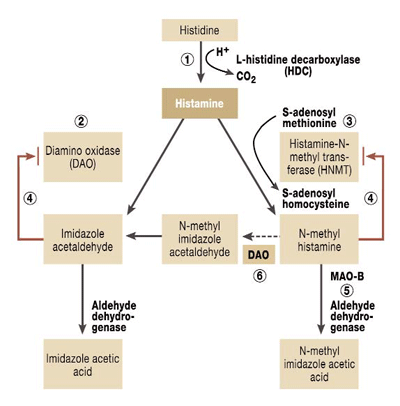
Histamine is predominantly metabolized via N-methytransferese to 1-methylhistamine, which is further processed to N-methylimidazole acetic acid, while the remainder is metabolized by diamine oxidase to imidazole acetic acid (Fig.1). The urinary 1-methylhistamine level correlates well with the histamine levels in plasma and urine (1,2), and is more stable than histamine in plasma.
The determination of urinary 1-methylhistamine finds it application primarily in the diagnosis and monitoring of mast-cell disorders, including mastocytosis, anaphylaxis, and other severe systemic allergic reactions.
Literature
1. Hermann K. et al. Measurement and characterization of histamine and methylhistamine in human urine under histamine-rich and histamine-poor diets. Int Arch Allergy Immunol. 1993;101(1):13-9.
2. Belic A. et al. Interdependence of histamine and methylhistamine kinetics: modelling and simulation approach. Comput Biol Med. 1999 Nov;29(6):361-75.
3. Maintz L. et al. Histamine and histamine intolerance. Am J Clin Nutr 2007;85:1185–96.
Histamin (Nomenklatur: 2-(4-Imidazolyl)-ethylamin) ist ein Naturstoff, der im menschlichen und tierischen Organismus weit verbreitet ist. Es ist gut wasserlöslich und hat einen basischen Charakter. Histamin gehört biochemisch zu den biogenen Aminen und wird aus der Aminosäure Histidin gebildet. Diese Decarboxylierung erfolgt mit Hilfe des Enzyms Histidindecarboxylase. Die Biosynthese des Histamins findet in den Mastzellen, Zellen der Epidermis und der Magenschleimhaut und in den Nervenzellen statt.
Aus Mastzellen und basophilen Granulozyten kann das Histamin explosionsartig freigesetzt werden und zwar bei der Stimulation der Speicherzellen mit dem entsprechenden Allergen. Diese Stimulation erfolgt durch die Bindung des Allergens an die spezifischen IgE-Antikörper auf der Oberfläche der Zielzellen. Wobei dieser Effekt noch nicht bei dem ersten Kontakt mit einem Allergen auftritt. Zunächst erfolgt durch den Erstkontakt die Bildung von Plasmazellen, die spezifische IgE-Antikörper produzieren und freisetzen. Diese binden an die entsprechenden Rezeptoren der Mastzellen (Sensibilisierung). Erst beim nächsten Allergen-Kontakt können die Allergene direkt an die IgE-Antikörper der Mastzellen binden und damit wird die spontane Histaminausschüttung aus der Granula der Mastzellen ausgelöst (allergische Sofortreaktion).
Zirkulierendes Histamin wird durch die Histamin-N-Methyltransferase schnell zu 1-Methylhistamin (N-Methylhistamin) umgesetzt. Die Ausscheidung erfolgt im Urin und dadurch ist die Bestimmung dieses Metaboliten im Urin von Interesse. Der 1-Methylhistamin-ELISA-Kit enthält Reagenzien für die quantitative Bestimmung von derivatisiertem 1-Methylhistamin in Urin-, Plasma- und Zellkulturproben. Die Derivatisierung erfolgt während der Probenvorbereitung. Dabei wird 1-Methylhistamin durch das Acylierungsreagenz quantitativ in N-Acyl- 1-Methylhistamin umgewandelt.
Distributed by IBL InternationalFor concrete data please consult the Instruction for Use in the download box on the top right side.
Our comprehensive immunoassay portfolio includes a number of specialty diagnostic immunoassays for endocrinology, immunology and autoimmunity, as well as for diagnosis of multiple infectious diseases. We are pioneers and market leaders in saliva diagnostics, with over 40 years of experience supplying a broad portfolio of luminescence- and ELISA-based tests, including our highly acclaimed HMGB1 and MuSK-Ab ELISAs.
And as experts in laboratory automation, we can support our customers with the protocols for open ELISA platforms, such as the Freedom EVOlyzer or Thunderbolt®.
All products are only available for sale to laboratory professionals and may not be available in all countries. Availability and regulatory status may vary across regions depending on local country-specific registration. Please always read and follow the instructions for use.
All of our assays have been designed and manufactured to meet the highest global regulatory requirements and quality standards. Tecan is certified under ISO 9001:2015, ISO 13485:2016 and is audited by a notified body according to Medical Device Single Audit Program (MDSAP).

As part of the Tecan Group, we have a leading market position in diagnostics and research, with over 40 years of experience in the development, manufacture and supply of enzyme-, radiolabel- and luminescence-based immunoassays.
Our range of high-quality immunoassays is supported by a diverse portfolio of automated solutions, making us the perfect partner for you and your customers.
At Tecan, we are driven to improve people’s lives and health.