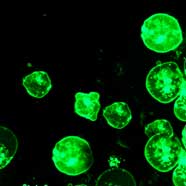
dsDNA-Ab RIA
- Regulatory Status
- EU: CE IVDR
- Kit size
- 100
- Method
- RIA
- Incubation time
- 1x1h
- Standard range
- 0 - 80 IU/mL, normal range 0 - 7 IU/mL
- Specimen / Volumes
- 25 µL serum
- Substrate / isotope
- 125I < 74 kBq






Radio immunoassay for the quantitative determination of antibodies against double-stranded DNA (dsDNA) in adult human serum. The device is intended as an aid in the diagnosis of SLE in patients suspected of Systemic lupus erythematosus (SLE) disease, a systemic and clinically heterogeneous autoimmune disease characterized by autoantibody formation. The presence of anti-dsDNA-Ab is highly characteristic for patients with SLE. It is intended as an aid in the diagnosis of SLE, as well as for antibody quantification before and during disease and as a followup/monitoring e.g. of treatments and disease progression. The test kit is intended for manual and professional laboratory use by trained personnel. The test kit is not for home or layperson use.
Systemic lupus erythematosus (SLE) is classified among the diseases of the collagenosis. It is a systemic and clinically heterogeneous autoimmune disease characterized by autoantibody formation. The disease can affect almost any part of the body and is characterized by remission and relapses. It is mostly affecting women of reproductive age (women are ten times more affected than men) but can be present at any age and gender. [1-4] Anti-nuclear antibodies (ANA), a heterogeneous group of autoantibodies to nuclear antigens in human serum or plasma, are frequently tested as a screening tool in patients with suspected systemic lupus erythematosus (SLE) or other connective tissue diseases. Anti-double-stranded DNA antibodies (anti-dsDNA) are part of antibodies detected by ANA and are commonly tested in SLE. ANA and anti-dsDNA are two well established criteria for classification of SLE. [5,6] Analysis of antibodies against double-stranded (ds) DNA is an important diagnostic tool for determination of SLE, and changes in anti-dsDNA antibody levels are also used to assess disease activity. [7,8] Several factors can influence the formation and amount of dsDNA autoantibodies in SLE patients. These include smoking, vitamin D deficiency, hormone therapy, but also past viral or bacterial infections as well as environmental influences or drugs. The patient's history must be taken into account for a detailed analysis of the development of the antibodies. Farr-RIA assay detects high-avidity antibodies quantitatively. This assay has the best correlation with disease activity and the highest specificity for lupus compared to other methods. The Farr assay is considered as the ‘gold standard’ for clinicians as so far it is the most specific assay for positive diagnosis of SLE and discrimination between other autoimmune diseases [1,9,10]
* Product availability and regulatory status may vary across regions outside the EU depending on local country-specific registration. Consult with your Tecan associate for further information.
For concrete data please consult the Instruction for Use in the download box on the top right side.
1. Thomas, L. (2012). Labor und Diagnose: Indikation und Bewertung von Laborbefunden für die medizinische Diagnostik, Frankfurt/Main: Th-Books Verl. 1786-1798.
2. Smith, P. P., & Gordon, C. (2010). Systemic lupus erythematosus: clinical presentations. Autoimmunity reviews, 10(1), 43-45.
3. Yu, C., Gershwin, M. E., & Chang, C. (2014). Diagnostic criteria for systemic lupus erythematosus: a critical review. Journal of autoimmunity, 48, 10-13.
4. Munoz, L. E., Gaipl, U. S., & Herrmann, M. (2008). Predictive value of anti-dsDNA autoantibodies: importance of the assay. Autoimmunity reviews, 7(8), 594-597.
5. Wichainun, R., Kasitanon, N., Wangkaew, S., Hongsongkiat, S., Sukitawut, W., & Louthrenoo, W. (2013). Sensitivity and specificity of ANA and anti-dsDNA in the diagnosis of systemic lupus erythematosus: a comparison using control sera obtained from healthy individuals and patients with multiple medical problems. Asian Pacific journal of allergy and immunology, 31(4), 292.
6. Ippolito, A., Wallace, D. J., Gladman, D., Fortin, P. R., Urowitz, M., Werth, V., ... & Petri, M. (2011). Autoantibodies in systemic lupus erythematosus: comparison of historical and current assessment of seropositivity. Lupus, 20(3), 250-255.
7. Kuhn, A., Bonsmann, G., Anders, H. J., Herzer, P., Tenbrock, K., & Schneider, M. (2015). The diagnosis and treatment of systemic lupus erythematosus. Deutsches Ärzteblatt International, 112(25), 423.
8. Enocsson, H., Sjöwall, C., Wirestam, L., Dahle, C., Kastbom, A., Rönnelid, J., ... & Skogh, T. (2015). Four anti-dsDNA antibody assays in relation to systemic lupus erythematosus disease specificity and activity. The Journal of rheumatology, 42(5), 817-825.
9. Rouquette, A. M., & Desgruelles, C. (2006). Detection of antibodies to dsDNA: an overview of laboratory assays. Lupus, 15(7), 403-407. 10. Kurien, B. T., & Scofield, R. H. (2006). Autoantibody determination in the diagnosis of systemic lupus erythematosus. Scandinavian journal of immunology, 64(3), 227-235.
Our comprehensive immunoassay portfolio includes a number of specialty diagnostic immunoassays for endocrinology, immunology and autoimmunity, as well as for diagnosis of multiple infectious diseases. We are pioneers and market leaders in saliva diagnostics, with over 40 years of experience supplying a broad portfolio of luminescence- and ELISA-based tests, including our highly acclaimed HMGB1 and MuSK-Ab ELISAs.
And as experts in laboratory automation, we can support our customers with the protocols for open ELISA platforms, such as the Freedom EVOlyzer or Thunderbolt®.
All products are only available for sale to laboratory professionals and may not be available in all countries. Availability and regulatory status may vary across regions depending on local country-specific registration. Please always read and follow the instructions for use.
All of our assays have been designed and manufactured to meet the highest global regulatory requirements and quality standards. Tecan is certified under ISO 9001:2015, ISO 13485:2016 and is audited by a notified body according to Medical Device Single Audit Program (MDSAP).

As part of the Tecan Group, we have a leading market position in diagnostics and research, with over 40 years of experience in the development, manufacture and supply of enzyme-, radiolabel- and luminescence-based immunoassays.
Our range of high-quality immunoassays is supported by a diverse portfolio of automated solutions, making us the perfect partner for you and your customers.
At Tecan, we are driven to improve people’s lives and health.