5-alpha Dihydrotestosterone (DHT) ELISA
- Regulatory Status
- EU: CE
- Kit size
- 12 x 8
- Method
- ELISA
- Incubation time
- 1 x 1 h, 1 x 10 min
- Standard range
- 25 - 2500 pg/mL
- Specimen / Volumes
- 50 µL serum/without extraction
- Substrate / isotope
- TMB 450 nm






Tecan offers the direct ELISA for measuring 5α–Dihydrotestosterone (DHT) in serum. Results can be obtained within 2 hours. Measuring DHT levels finds its application in gynecology, pediatrics, endocrinology, and biochemistry.
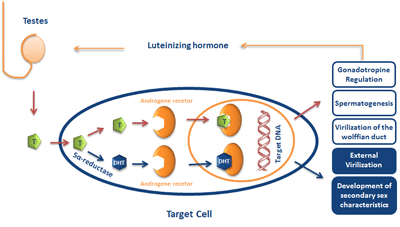
DHT is essential for the development of the male sex characteristics before birth, particularly the formation of the external genitalia. In the adult, DHT is needed to develop and maintain male gender characteristics, such as facial hair, deep voice, and muscle growth. In women, DHT may induce the onset of puberty and causes body and pubic hair growth.
In males, about 70% of DHT is derived from the conversion of testosterone by 5α–Reductase in the prostate, testes, hair follicles, and adrenal glands. In females, most of the DHT is derived from androstenedione. DHT has approximately 3 times greater affinity for androgen receptors than testosterone and has 15-30 times greater affinity than adrenal androgens.
5α–Reductase deficiency can result in pseudo–hermaphroditism. DHT is the primary contributing factor in male pattern baldness and may contribute to the development of benign prostatic hyperplasia, as well as prostate cancer. Women with increased levels of DHT may suffer from female androgenism by developing androgynous secondary sex characteristics.
Synonyms
Androstanolone (5α–Androstan–17β–ol–3–one)
17β–hydroxy–5α–Androstan–3–one
DHT is the best marker for female androgenism, complementary marker to testosterone. Increased DHT levels are found in about 40% of patients with idiopathic hirsutism and 35% of patients with polycystic ovarian syndrome.Women with too much DHT may develop increased body, facial and pubic hair growth, amenorrhea, and increased acne. Abnormal changes to the genitalia may also occur in women with too much DHT.
DHT is the primary contributing factor in male pattern baldness (MPB) or Androgenic alopecia. Men with MPB typically have higher levels of DHT, lower levels of total testosterone, and higher levels of free testosterone. The target intervention for the patients that suffer from baldness is to prevent DHT from acting on scalp androgen receptors.
DHT plays a role in the development and exacerbation of benign prostatic hyperplasia, as well as prostate cancer, by enlarging the prostate gland. Prostate growth and differentiation are highly dependent on sex steroid hormones, particularly DHT.
Patients presenting with 46 XY karyotype and female or ambiguous genitalia may lack the enzyme testosterone 5α–reductase. This gene lesion can result in pseudohermaphroditism. This condition typically presents with underdeveloped male genitalia and prostate. These individuals are often raised as girls due to their lack of conspicuous male genitalia. At the onset of puberty, although their DHT levels remain very low, their testosterone levels elevate normally. Their musculature develops like that of other male adults. After puberty, men with this condition have a large deficiency of pubic and body hair and no incidence of male pattern baldness.
5α–reductase deficiency can be diagnosed after puberty by measurement of testosterone and DHT concentrations.
Excerpt from the Instructions for Use
Enzyme immunoassay for the in-vitro-diagnostic quantitative determination of 5alpha-Dihydrotestosterone in human serum.
Dihydrotestosterone (DHT) is the most active natural androgen in humans with a principal role in the development of primary and secondary sexual characteristics and potential participation in a myriad of other physiological processes. The bulk of androgen production takes place mainly in the Leydig cells of the testes.
Androgens circulate in the blood bound to proteins, especially sex hormone binding globulin (SHBG) from peripheral conversion of testosterone, while in females most of the DHT is derived from androstenedione.
Some of the main clinical indications of the DHT measurement in serum are investigations of delayed puberty in men and evaluation of the presence of active testicular tissue.
For concrete data please consult the Instruction for Use in the download box on the top right side.
Our comprehensive immunoassay portfolio includes a number of specialty diagnostic immunoassays for endocrinology, immunology and autoimmunity, as well as for diagnosis of multiple infectious diseases. We are pioneers and market leaders in saliva diagnostics, with over 40 years of experience supplying a broad portfolio of luminescence- and ELISA-based tests, including our highly acclaimed HMGB1 and MuSK-Ab ELISAs.
And as experts in laboratory automation, we can support our customers with the protocols for open ELISA platforms, such as the Freedom EVOlyzer or Thunderbolt®.
All products are only available for sale to laboratory professionals and may not be available in all countries. Availability and regulatory status may vary across regions depending on local country-specific registration. Please always read and follow the instructions for use.
All of our assays have been designed and manufactured to meet the highest global regulatory requirements and quality standards. Tecan is certified under ISO 9001:2015, ISO 13485:2016 and is audited by a notified body according to Medical Device Single Audit Program (MDSAP).
As part of the Tecan Group, we have a leading market position in diagnostics and research, with over 40 years of experience in the development, manufacture and supply of enzyme-, radiolabel- and luminescence-based immunoassays.
Our range of high-quality immunoassays is supported by a diverse portfolio of automated solutions, making us the perfect partner for you and your customers.
At Tecan, we are driven to improve people’s lives and health.