



Offline-Modus

Brain-derived Tau detection – made simple in blood.

The Brain-derived Tau (BD-Tau) LUM is a sensitive and accessible research-use only blood assay. Combining a specific antibody targeting brain-derived Tau with upfront immunoprecipitation, BD-Tau LUM offers researchers a powerful and accessible tool to investigate Alzheimer's disease pathology, progression, and biomarker dynamics in plasma.

Request your trial kit now!

The Human BD Tau Luminescence Immunoassay is an enzyme immunoassay intended for the quantitative determination of brain derived TAU protein from peripheral cell free body fluids as blood plasma or serum after enrichment of BD Tau using the BD-Tau Neuro IP Kit (30260912).

Summary

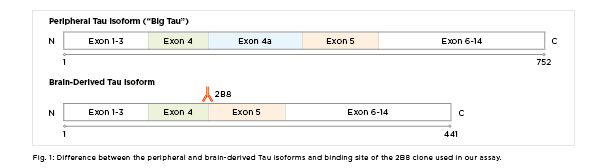
The Tau protein is a microtubule-stabilizing protein being part of the axons of nerve cells in the central nervous system (CNS). Measuring total Tau in CSF reflects axonal destruction and has found its way into diagnostic criteria guidelines¹, but measuring total Tau in blood does not correlate with its corresponding CSF value. As 80% of Tau in blood originates from peripheral tissue, being able to selectively measure the brain-derived fraction will enhance specificity and accessibility of Tau as an AD biomarker. The antibody used in the BD-Tau LUM is targeting the brain-derived Tau isoform only.

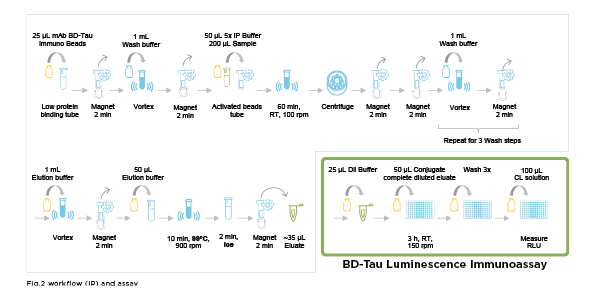
The analysis of brain-derived Tau is coupled with a pre-analytical immunoprecipation (IP) step to enhance better detection in the later assay.

Values of measuring BD-Tau

  • Detection of brain-specific Tau fractions
  • BD-Tau provides a more specific signal of neurodegeneration compared to total Tau measured in plasma²
  • Measurement of BD-Tau in blood samples correlates well to total Tau measurements in CSF³
  • Enables longitudinal assessment of biomarker level changes related to Alzheimer’s disease⁴
  • Reflects disease severity and progression trends supporting biomarker discovery and validation⁴
  • Complementary to measuring Amyloid-beta 1-42 and pTau217 in plasma helping to stratify participants based on recommendation of anti-amyloid treatment studies⁴

Using an assay to detect BD-Tau in blood samples provides a low-invasive research tool to help screen and stratify participants for different kinds of studies.

Distributed by TECAN, IBL international

Für konkrete Daten konsultieren Sie bitte die Arbeitsanweisung in der Download Box oben auf der rechten Seite.

  1. Jack, C. R., Jr, Andrews, S. J., Beach, T. G., Buracchio, T., Dunn, B., Graf, A., Hansson, O., Ho, C., Jagust, W., McDade, E., Molinuevo, J. L., Okonkwo, O. C., Pani, L., Rafii, M. S., Scheltens, P., Siemers, E., Snyder, H. M., Sperling, R., Teunissen, C. E., & Carrillo, M. C. (2024). Revised criteria for the diagnosis and staging of Alzheimer's disease. Nature medicine, 30(8), 2121–2124. https://doi.org/10.1038/s41591-024-02988-7
  2. Gonzalez-Ortiz, F., Turton, M., Kac, P. R., Smirnov, D., Premi, E., Ghidoni, R., Benussi, L., Cantoni, V., Saraceno, C., Rivolta, J., Ashton, N. J., Borroni, B., Galasko, D., Harrison, P., Zetterberg, H., Blennow, K., & Karikari, T. K. (2023). Brain-derived tau: a novel blood-based biomarker for Alzheimer's disease-type neurodegeneration. Brain : a journal of neurology146(3), 1152–1165. https://doi.org/10.1093/brain/awac407
  3. Gonzalez-Ortiz, F., Dias, A., Turton, M., Magalhães, R., Kac, P. R., Correia, M., Harrison, P., Zetterberg, H., Maia, L. F., Blennow, K., & Karikari, T. K. (2023). Preanalytical stability of plasma/serum brain-derived tau. Alzheimer's & dementia : the journal of the Alzheimer's Association19(10), 4764–4770. https://doi.org/10.1002/alz.13156
  4. Gonzalez-Ortiz, F., Kirsebom, B. E., Contador, J., Tanley, J. E., Selnes, P., Gísladóttir, B., Pålhaugen, L., Suhr Hemminghyth, M., Jarholm, J., Skogseth, R., Bråthen, G., Grøndtvedt, G., Bjørnerud, A., Tecelao, S., Waterloo, K., Aarsland, D., Fernández-Lebrero, A., García-Escobar, G., Navalpotro-Gómez, I., Turton, M., … Blennow, K. (2024). Plasma brain-derived tau is an amyloid-associated neurodegeneration biomarker in Alzheimer's disease. Nature communications15(1), 2908. https://doi.org/10.1038/s41467-024-47286-5

Unsere Produktfamilien

Zu unserem umfassenden Angebot an Immunassays gehören eine Reihe spezialisierter diagnostischer Immunassays für die Endokrinologie, Immunologie und zur Untersuchung von Autoimmunkrankheiten, sowie zur Diagnose von zahlreichen Infektionskrankheiten. Wir sind Pioniere und Marktführer in der Speicheldiagnostik, und bieten seit über 40 Jahren ein breites Portfolio an Lumineszenz- und ELISA-basierten Tests.

Als Experten im Bereich Laborautomation unterstützen wir unsere Kunden mit Protokollen für offene ELISA-Plattformen wie dem Freedom EVOlyzer oder dem Thunderbolt®.

Sämtliche Produkte sind nur für den Verkauf an Laborpersonal verfügbar und möglicherweise nicht in allen Ländern erhältlich. Bitte lesen und befolgen Sie immer die Arbeitsanleitung. Kontaktieren Sie uns gerne für weitere Informationen.

Design und Herstellung aller unserer Assays erfüllen die höchsten Anforderungen globaler Richtlinien und Qualitätsstandards. Tecan ist unter ISO 9001:2015, ISO 13485:2016 zertifiziert und gemäß Medical Device Single Audit Program (MDSAP) von einer Benannten Stelle auditiert.

Image on background

Das sind wir.

Als Teil der Tecan-Gruppe haben wir eine führende Marktposition in Diagnostik und Forschung. Wir verfügen über 40 Jahre Erfahrung in der Entwicklung, Herstellung und Bereitstellung von Immunassays auf Basis von Enzymreaktionen, Radiomarkierungen und Lumineszenz.

Unsere Bandbreite hochqualitativer Immunassays wird durch ein vielfältiges Portfolio automatisierter Lösungen ergänzt. So sind wir der perfekte Partner für Sie und Ihre Kunden.

Happy to help.

At Tecan, we are driven to improve people’s lives and health.