





Neurodegenerative diseases.
Why do we measure what we measure?

Oliver Schmidt,
Product Manager at Tecan
Neurodegenerative diseases (NDs) affect millions of people worldwide, with age, genetics and environmental factors contributing to increasing risk. All NDs are characterized by the loss of neurons, resulting in cognitive or functional impairment, or sometimes both. For example, Alzheimer’s disease (AD), Creutzfeldt-Jakob disease and frontotemporal dementia (FTD) are conditions that predominantly cause cognitive decline, while Parkinson’s disease (PD), multiple sclerosis (MS) and amyotrophic lateral sclerosis (ALS) – the condition that affected Stephen Hawking – all inflict motor function impairment. One of the key challenges in diagnosing these conditions is the high overlap of symptoms, especially those causing cognitive impairment. However, more recent research has identified a number of proteins that can aid in the characterization of NDs, leading to the development of assays – such as those supplied by Tecan – that could help to guide both clinicians and further research in the field.
Protein power
Many NDs have been classified as neurodegenerative proteinopathies over recent decades, as they result in the accumulation of misfolded proteins in the brain. These atypical protein conformations – or amyloids – are thought to be the cause of almost 50 conditions, and are likely shaped by primary amyloid-forming proteins that contribute differentially towards disease prognosis.1 Resolving these protein patterns at the proteoform level – a specific molecular variant of a protein that includes post-translational modifications – could therefore lead to huge advances in how we diagnose and treat these disorders. In the meantime, assays are available to measure many of the proteins thought to be involved in CSF and serum, potentially aiding the diagnosis and management of various conditions.
Alzheimer’s disease (AD)
AD is one of the most common neurodegenerative proteinopathies, and has been the subject of much research since the early nineties, leading to the discovery of specific proteins involved in its pathology. Current theory suggests that patients with AD have lowered amyloid-beta 1-42 (Aβ1-42) and elevated tubulin-associated unit (TAU) levels compared to healthy controls. However, these proteins also play a role in the pathogenesis of other NDs, and additional proteins must be measured in conjunction to improve diagnostic accuracy. For example, increased TAU levels in the brain are also representative of FTD, but elevated phosphorylated TAU (pTAU) is a hallmark of AD alone, and so measuring both markers can aid differential diagnosis.
Furthermore, measuring Aβ1-42 by itself can produce false positive or negative results, but the ratio of Aβ1-42 to amyloid-beta 1-40 (Aβ1-40) has been shown to be a superior diagnostic marker for AD.2 This can help to distinguish between AD and other dementias, such as vascular dementia, dementia with Lewy bodies and FTD.3 These proteins feature heavily in the latest paper by the International Working Group for AD, which recognizes the diagnosis of AD should be based on both clinical and biological characteristics, recommending Aβ1-42, Aβ1-42:Aβ1-40 ratio and pTAU as favorable biomarkers.4
Top products
Tecan’s leading range of assays includes a bundle that measures these biomarkers, which are CE-marked in Europe:
Neurofilaments
Another set of biomarkers garnering interest for the management of NDs is neurofilament proteins. These are structural components of myelinated axons on neurons, which define the shape and diameter of the axon, as well as playing a crucial role in signal propagation. The neurofilament light chain (NF-L) is a subunit that is especially of interest to the management of many NDs, as its level increases in the CSF and blood in proportion to the degree of axonal damage.5 Being able to identify and quantify axonal damage could help to improve diagnostic and prognostic accuracy for many diseases, including MS and ALS.5
Multiple sclerosis
MS causes demyelination of neurons, leading to axonal degradation that results in the debilitating symptoms suffered by patients. As a result, neurofilaments are released into the CSF, increasing the concentration of NF-L.6 Elevated NF-L levels in CSF could therefore be used as a prognostic marker in MS, both for clinically isolated syndrome – the first bout of MS – and relapsing-remitting MS, as well as for assessing treatment success.7 NF-L also appears in the serum of patients with MS, with multiple studies highlighting the correlation between serum and CSF NF-L levels, indicating that blood sampling could potentially replace CSF testing.6,8
Amyotrophic lateral sclerosis
Similarly, NF-L is found at high levels in both CSF and serum of patients with ALS, and an increasing weight of evidence supports its claim as an accurate biomarker for this condition.9 NF-L levels were found to be significantly higher in patients with the onset of early symptoms, indicating this biomarker has the potential to enhance diagnostic accuracy at first presentation.10 It is also appealing for improving prognostic accuracy, by being able to more closely measure patients’ pharmacodynamic response to treatment.9
Top product
Tecan offers an assay to help quantify NF-L in CSF:
With an increasing number of people living with neurodegenerative diseases, innovative methods to improve diagnosis and monitor treatment are essential. The novel biomarkers and assays discussed here provide more information to help distinguish between conditions for patients presenting with similar symptoms, potentially aiding in earlier diagnosis and treatment monitoring.
Measuring neuronal biomarkers in blood
As CSF has disadvantages in sampling and not all patients receive a lumbar puncture (e.g. PD, LBD patients), studies have shown the usefulness of measuring certain biomarkers also in blood.
Boost your blood plasma data
Easily eliminate inhibiting matrix effects and enrich your target by immunoprecipitation using TECAN’s NEURO IP product portfolio provided by Roboscreen for total TAU, p50Tau, brain-derived TAU, beta-Amyloid, and patho-oligomeric alpha-Synuclein, enhancing the performance of your downstream assay of choice. The downstream analysis can then be any type of assay system, such as the Roche Elecsys®, the Mesoscale QuickPlex, Quanterix SIMOA®, Fujirebio Lumipulse® or even any type of ELISA.
Top products, distributed by Tecan, IBL International GmbH
Brain-derived Tau (BD-Tau) and BD-p217-Tau
The AT(N) (amyloid, tau, neurodegeneration) research framework provides a unified scheme that emphasizes the pathophysiological evidence of amyloid beta (A), tau (T) and neurodegeneration (N) for the definition and staging of Alzheimer’s disease.4,11,12
Total tau has long been recognized as a marker of neurodegeneration in CSF, but its utility in blood is limited. The majority of blood total Tau originates from peripheral tissue, not the CNS, and is elevated in a range of conditions, including Creutzfeldt-Jakob disease (CJD), head trauma and anoxia, among others.
The rationale to develop brain-derived Tau specific assays lies in the properties of the Tau protein. Tau exists in multiple isoforms. Whereas CNS tau is characterized by low molecular weight forms, peripheral nervous system (PNS) tau is characterized by a larger isoform known as “big tau”.13 This main form of Tau in the PNS can be distinguished from the different CNS isoforms by the presence of a large peptide insert from the transcription of an extra exon (exon 4a).14 Traditional total Tau assays use antibodies that target regions shared by CNS and PNS tau. To address this, our BD-Tau Luminescence immunoassay as well as our Neuro Immunoprecipitation Kit use a Tau junction antibody (2B8) that will not bind if the “big tau” insert is present (see figure below).
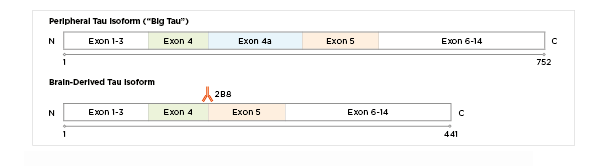
Performing an immunoprecipitation step before the actual assay has been shown to enhance the discriminatory power of the subsequently measured biomarkers, especially in blood samples.15-17
Top products, distributed by Tecan, IBL International GmbH
More information
To find out more or to see our full portfolio please visit:
References
- Noor A, et al. Neurodegenerative Proteinopathies in the Proteoform Spectrum-Tools and Challenges. Int J Mol Sci. 2021;22(3):1085. doi: 10.3390/ijms22031085.
- Wiltfang J, et al. Amyloid beta peptide ratio 42/40 but not A beta 42 correlates with phospho-Tau in patients with low- and high-CSF A beta 40 load. J Neurochem. 2007;101(4):1053-9. doi: 10.1111/j.1471-4159.2006.04404.x.
- Spies PE, et al. The cerebrospinal fluid amyloid beta42/40 ratio in the differentiation of Alzheimer's disease from non-Alzheimer's dementia. Curr Alzheimer Res. 2010;7(5):470-476. doi:10.2174/156720510791383796.
- Dubois B, et al. Clinical diagnosis of Alzheimer's disease: recommendations of the International Working Group. Lancet Neurol. 2021;20(6):484-496. doi:10.1016/S1474-4422(21)00066-1.
- Gaetani L, et al. Neurofilament light chain as a biomarker in neurological disorders. J Neurol Neurosurg Psychiatry. 2019;90(8):870-881. doi:10.1136/jnnp-2018-320106.
- Novakova L, et al. Monitoring disease activity in multiple sclerosis using serum neurofilament light protein. Neurology. 2017;89(22):2230-2237. doi:10.1212/WNL.0000000000004683.
- Varhaug KN, et al. Neurofilament Light Chain as a Biomarker in Multiple Sclerosis. Front Neurol. 2019;10:338. doi:10.3389/fneur.2019.00338.
- Kuhle J, et al. Blood neurofilament light chain as a biomarker of MS disease activity and treatment response. Neurology. 2019;92(10):e1007-e1015. doi:10.1212/WNL.0000000000007032.
- Lu CH, et al. Neurofilament light chain: A prognostic biomarker in amyotrophic lateral sclerosis [published correction appears in Neurology. 2015;8;85(10):921]. Neurology. 2015;84(22):2247-2257. doi:10.1212/WNL.0000000000001642.
- Feneberg E, et al. Multicenter evaluation of neurofilaments in early symptom onset amyotrophic lateral sclerosis. Neurology. 2018;90(1):e22-e30. doi:10.1212/WNL.0000000000004761.
- Jack CR Jr, Bennett DA, Blennow K, Carrillo MC, Dunn B, Haeberlein SB, Holtzman DM, Jagust W, Jessen F, Karlawish J, Liu E, Molinuevo JL, Montine T, Phelps C, Rankin KP, Rowe CC, Scheltens P, Siemers E, Snyder HM, Sperling R, et al. NIA-AA Research Framework: Toward a biological definition of Alzheimer's disease. Alzheimer's & Dementia. 2018;14(4):535-562.
https://doi.org/10.1016/j.jalz.2018.02.018 - Jack CR Jr, Bennett DA, Blennow K, Carrillo MC, Feldman HH, Frisoni GB, Hampel H, Jagust WJ, Johnson KA, Knopman DS, Petersen RC, Scheltens P, Sperling RA, Dubois B. A/T/N: An unbiased descriptive classification scheme for Alzheimer disease biomarkers. Neurology. 2016;87(5):539-547.
https://doi.org/10.1212/WNL.0000000000002923 - Fischer I, Baas PW. Resurrecting the Mysteries of Big Tau. Trends Neurosci. 2020;43(7):493-504.
https://doi.org/10.1016/j.tins.2020.04.007 - Couchie D, Mavilia C, Georgieff IS, Liem RK, Shelanski ML, Nunez J. Primary structure of high molecular weight tau present in the peripheral nervous system. Proc Natl Acad Sci U S A. 1992;89(10):4378-4381.
https://doi.org/10.1073/pnas.89.10.4378 - Klafki HW, Vogelgsang J, Manuilova E, Bauer C, Jethwa A, Esselmann H, Jahn-Brodmann A, Osterloh D, Lachmann I, Breitling B, Rauter C, Hansen N, Bouter C, Palme S, Schuchhardt J, Wiltfang J. Diagnostic performance of automated plasma amyloid-β assays combined with pre-analytical immunoprecipitation. Alzheimers Res Ther. 2022;14(1):127.
https://doi.org/10.1186/s13195-022-01071-y - Klafki HW, Morgado B, Wirths O, Jahn O, Bauer C, Esselmann H, Schuchhardt J, Wiltfang J. Is plasma amyloid-β 1-42/1-40 a better biomarker for Alzheimer's disease than AβX-42/X-40? Fluids Barriers CNS. 2022;19(1):96.
https://doi.org/10.1186/s12987-022-00390-4 - Morgado B, Klafki HW, Bauer C, Waniek K, Esselmann H, Wirths O, Hansen N, Lachmann I, Osterloh D, Schuchhardt J, Wiltfang J. Assessment of immunoprecipitation with subsequent immunoassays for the blood-based diagnosis of Alzheimer's disease. Eur Arch Psychiatry Clin Neurosci. 2025;275(8):2215-2227.
https://doi.org/10.1007/s00406-023-01751-2