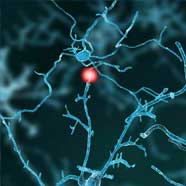
Over the last 15 years measuring Amyloid–beta (1–42) peptide has gained acceptance as a tool to aid in the diagnosis of Alzheimer´s disease. Yet, clinical sensitivity and specificity usually is less than 85%. This can be largely attributed to the Gaussian distribution of Amyloid–beta production in the population. It leads to false positives in the group of "low" Abeta producers and to false negatives in the group of "high" Abeta producers. Normalizing the Amyloid–beta (1–42) values to the most abundant and stably produced Abeta (1–40) isoform overcomes this limitation and significantly improves the diagnostic value to well above 90%. IBL International has set its goal to develop high quality immunoassays for convenient and accurate measurement of Amyloid–beta (1–40) and Amyloid–beta (1–42) in CSF for optimal ratio Determination as can be seen by excellent cross reactivity data of both assays (Table 1)
Peptide
Amyloid–beta (1–40) ELISA
Amyloid–beta (1–42) ELISA
Amyloid–beta (1–42)
0,84%
100%
Amyloid–beta (1–40)
100%
0,003%
Amyloid–beta (1-38)
0,01%
0,57%
Amyloid–beta (2-40)
1,29%
0,02%
Tabelle 1 Kreuzreaktivitäten (bestimmt nach Deshpande, SS (1996))
Both Assays show excellent inter– and intra–assay CVs (Table 2) and inter–lot CVs (Table 3) profiles due to internal quality control standards.
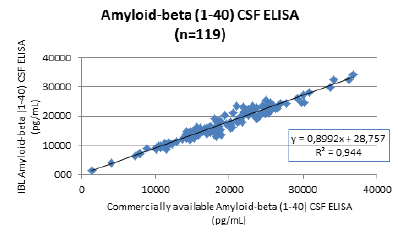
Method comparison with commercially available Amyloid–beta (1–40) ELISA: R2=0.944
Figure 1: Method comparison for the detection of Amyloid–beta (1–40) in 119 native CSF Samples
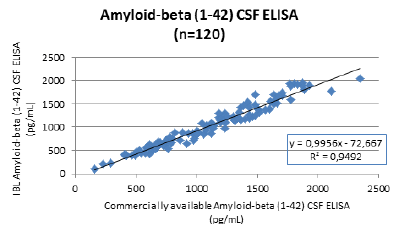
Method comparison with commercially availableAmyloid–beta (1–42) ELISA: R2 =0.9492
Figure 2: Method comparison for the detection of Amyloid–beta (1–42) in 120 native CSF Samples
To clinically validate the assays an external study was done at the "Klinik und Poliklinik für Psychiatrie und Psychotherapie, Klinikum rechts der Isar der Technischen Universität München, München, Germany" with overall83 clinically known samples. The ratio of both assay values shows highclinical sensitivity and specificity
Amyloid–beta (1–42) ⁄ Amyloid–beta (1–40) ratio superior to Amyloid–beta (1–42) alone
Ratio: Amyloid–beta (1–42) ⁄ Amyloid–beta (1–40)
AD
control
Diagnosis
AD
39
1
control
4
39
Similar results were obtained by Prof. Dr. med. Piotr Lewczuk, Lab for Clinical Neurochemistry and Neurochemical Dementia Diagnostics, Universitätsklinikum Erlangen, Department of Psychiatry and Psychotherapy, Erlangen, Germany. (to be published soon)
Excerpt from the Instructions for Use
In 2010, the number of dementia patients worldwide was estimated at 36 million. Assuming an ongoing lack of sufficient preventive and curative treatments, this is expected to double every 20 years. Alzheimer’s Disease accounts for roughly 60-70% of all dementia cases. Both prevalence and incidence increase with age. Prevalence is around 1% in those aged 65-69, and more than 30% in those aged 90 or older.
The development of the Disease is characterized by three stages, as defined by the US National Institute on Aging workgroups. A preclinical stage of Alzheimer’s Disease, the mild cognitive impairment (MCI) stage due to AD, and the dementia stage due to AD [9-11]. Amyloidosis occurs as early as the preclinical stage. The first cognitive deficits can manifest themselves in MCI stage, while in the dementia stage patients are unable to do any work or daily chores.
The concentration of amyloid-beta (1-42) is therefore recognized as a useful biomarker (in combination with other biomarkers such as Tau and Phospho-Tau) in diagnosing Alzheimer’s Disease. Moreover, a number of independent studies (for example [3-5]) showed the ratio of amyloid-beta (1-42) to amyloid-beta (1-40) to be a superior diagnostic marker for Alzheimer’s Disease.
For concrete data please consult the Instruction for Use in the download box on the top right side.
Our Product Families
Our comprehensive immunoassay portfolio includes a number of specialty diagnostic immunoassays for endocrinology, immunology and autoimmunity, as well as for diagnosis of multiple infectious diseases. We are pioneers and market leaders in saliva diagnostics, with over 40 years of experience supplying a broad portfolio of luminescence- and ELISA-based tests, including our highly acclaimed HMGB1 and MuSK-Ab ELISAs.
And as experts in laboratory automation, we can support our customers with the protocols for open ELISA platforms, such as the Freedom EVOlyzer or Thunderbolt®.
All products are only available for sale to laboratory professionals and may not be available in all countries. Availability and regulatory status may vary across regions depending on local country-specific registration. Please always read and follow the instructions for use.
All of our assays have been designed and manufactured to meet the highest global regulatory requirements and quality standards. Tecan is certified under ISO 9001:2015, ISO 13485:2016 and is audited by a notified body according to Medical Device Single Audit Program (MDSAP).
This is who we are.
As part of the Tecan Group, we have a leading market position in diagnostics and research, with over 40 years of experience in the development, manufacture and supply of enzyme-, radiolabel- and luminescence-based immunoassays.
Our range of high-quality immunoassays is supported by a diverse portfolio of automated solutions, making us the perfect partner for you and your customers.