Offline mode

IGFBP-3 ELISA

Buy on the e-shop
Catalog no.MD58031
Regulatory Status
EU: CE
Kit size
12 x 8
Method
ELISA
Incubation time
2 x 1 hr,1 x 30 min
Standard range
0.4 -30 ng/mL
Specimen / Volumes
10 µl Serum, Plasma
Substrate / isotope
TMB, 450 nm
instructions for usecertificateMSDS

Intended use

This enzyme immunoassay kit is suited for measuring IGFBP-3 in human serum, EDTA and Heparinplasma for diagnostic and scientific purposes.

Introduction

Insulin-like growth factors (IGF)-I and -II are bound to specific binding proteins (IGFBPs) in the circulation. To date, at least six binding proteins can be distinguished on the basis of their amino acid sequence. They are designated as IGFBP-1, IGFBP-2, ... IGPBP-6 (1). The predominating IGFBP in blood is IGFBP-3, which largely determines the total IGF-I and IGF-II concentration. In contrast to the other binding proteins, IGFBP-3 has the property to associate with an acid-labile subunit (ALS) after binding of either IGF-I or IGF-II (3-5). Most of the IGFBP-3 in plasma is present as high molecular weight ternary complex, however, small amounts of free IGFBP-3 are also found (6,7).

The development of a specific immunoassays for IGFBP-3, which detects IGFBP-3 in the ternary complex, provided new in-sights into IGFP-3 regulation (6-9). On the basis of these findings serum IGFBP-3 has been proven to be an additional useful test in the repertoire of diagnostic tools for evaluation of growth disorders (7,8).

Several factors besides GH influence IGFBP-3 levels: age including sexual development, nutrition, hypothyroidism, diabetes mellitus, liver function and kidney function. IGFBP-3 levels are decreased by malnutrition, although less than IGF-I, in hypothyroidism, in diabetes mellitus and in hepatic failure (6-8), but are increased in chronic renal failure (6,10,11). Measurement over 24 hours revealed no circadian rhythm (12,13). For clinical practice, the most important regulatory factor is GH. Single IGFBP-3 measurements correlate significantly with the logarithm of the integrated spontaneous GH secretion (8,14). In patients with GH deficiency, IGFBP-3 levels are subnormal and increase gradually to within the normal range after several days of GH administration (7,8). The slow response to GH and constant circadian levels during chronic daily application of GH (13) suggest that IGFBP-3 reflects the GH secretory state over days.

The major advantages of IGFBP-3 over IGF-I are:
  1. No extraction step is required prior to measurement thus improving test accuracy by simplifying the assay procedure.
  2. The normal range in young children is comparatively high making the detection of subnormal levels more reliable.
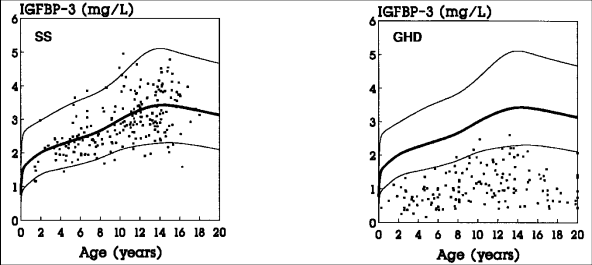
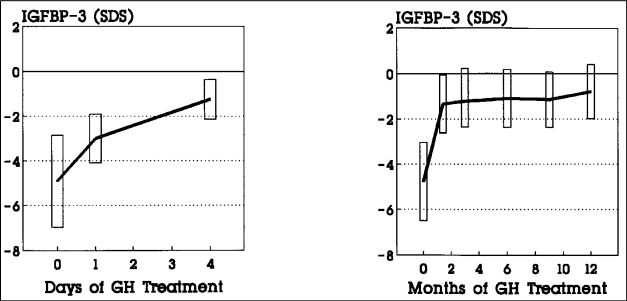
  3. Patients with GH deficiency have subnormal IGFBP-3 levels. In contrast, most of the small statured children with normal GH secretion have levels within the normal range (Figure 1). The separation of these two groups is easy. In small statured children IGFBP-3 levels rise to normal range within several days of GH administration and remain normal during continuous GH treatment (Figure 2). Therefore, serum IGFBP-3 measurements are also suited for evaluating the potential of a patient to respond to GH and for GH therapy monitoring (19). In other patients of severe short stature, e.g. Ullrich-Turner syndrome or Silver-Russell syndrome, IGFBP-3 levels were found normal (8) reflecting normal GH secretion.

Fig. 1: Serum IGFBP-3 levels in patients with short stature without GH deficiency (SS: constitutional delay of growth and adolescence, familial short stature, intra-uterine growth retardation) and in idiopathic or organic GH deficiency (GHD). The normal range is given by the 5th, 50th and 95th percentile.

Fig. 2: IGFBP-3 levels in GH deficient children before and during GH treatment. Because of the agedependence, values are given as the mean of standard deviation scores (SDS).
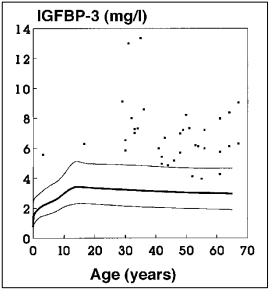
In normal tall children and adolescents without excessive GH secretion or in patients with Sotos syndrome, IGFBP-3 levels are normal or slightly increased. In contrast, children with pituitary gigantism or adults with acromegaly have clearly elevated levels (Figure 3) (6,15) that normalize on successful treatment. Therefore, IGFBP-3 is also a useful parameter for the detection of excessive GH secretion and monitoring therapy efficacy. In precocious puberty, IGFBP-3 levels are clearly increased by chronological age, whereas patients with premature thelarche have IGFBP-3 levels in the upper normal range (15).

Fig. 3: Serum IGFBP-3 levels in acromegaly. The normal range is given by the 5th, 50th and 95th percentile.
For concrete data please consult the Instruction for Use in the download box on the top right side.

  1. Ballard J, Baxter R, Binoux M, Clemmons D, Drop S, Hall K, Hintz R, Rechler M, Rutanen E, Schwander J (1989) On the nomenclature of the IGF binding proteins. Acta Endocrinol (Copenh) 121:751-752
  2. Wilson EM, Oh Y, Rosenfeld RG (1997) Generation and characterization of an IGFBP-7 antibody: Identification of 31 kD IGFBP-7 in human biological fluids and Hs578T human breast cancer conditioned media. J Clin Endocrinol Metab Vol 82, 4:1301-1303
  3. Baxter RC (1988) Characterization of the acid-labile subunit of the growth hormone- dependent insulin-like growth factor binding protein complex. J Clin Endocrinol Metab 67:265-272
  4. Baxter RC, Martin JL (1989) Structure of the Mr 140,000 growth hormone dependent insulin-like growth factor binding protein complex: determination by reconstitution and affinity-labeling. Proc Natl Acad Sci USA 86:6898-6902
  5. Holman SR, Baxter RC (1996) Insulin-like growth factor-binding protein-3: factors affecting binary and ternary complex formation. Growth Regulation 6: 42-47.
  6.  Baxter RC, Martin J (1986): Radioimmunassay of growth hormone-dependent insulin-like growth factor binding protein in human plasma. J Clin Invest 78:1504-1512
  7. Blum WF, Ranke MB, Kietzmann K, Gauggel E, Zeissel HJ, Bierich JR (1990) A specific radioimmunoassay for the growth hormone (GH)-dependent somatomedin-binding protein: its use for diagnosis of GH deficiency. J Clin Endocrinol Metab 70:1292-1298
  8. Blum WF, Ranke MB (1990) Use of insulin-like growth factor binding protein 3 for the evaluation of growth disorders. Horm Res 34 (Suppl):31-37
  9. Blum WF (1993) Insulin-like growth factor-binding protein 3: Entwicklung eines Radioimmunoassays und Untersuchungen zur klinischen Bedeutung. Habilitationsschrift, Tübingen.
  10. Lee PDK, Hintz RL, Sperry JB, Baxter RC, Powell DR (1989) IGF-binding proteins in growthretarded children with chronic renal failure. Pediatr Res 26:308-315
  11. Blum WF, Ranke MB, Kietzmann K, Tönshoff B, Mehls O (1989) Excess of IGF-binding proteins in chronic renal failure: evidence for relative GH resistence and inhibition of somatomedin activity. In: Drop SLS, Hintz RL (eds) Insulin-like Growth Factor Binding Proteins. Excerpta Medica, Amsterdam, pp 93-101
  12. Baxter RC, Cowell CT (1987) Diurnal rhythm of growth hormone-independent binding protein for insulin-like growth factors in human plasma. J Clin Endocrinol Metab 65:432- 440
  13. Jorgensen JOL, Blum WF, Moller N, Ranke MB, Christiansen JS (1990) Circadian patterns of serum insulin-like growth factor (IGF)-II and IGF-binding protein 3 in growth hormone deficient patients and age- and sex-matched normal subjects. Acta Endocrinol (Copenh.) 123:257-262
  14. Blum WF, Albertsson-Wikland K, Rosberg S, Jorgensen JOL, Ranke MB (1990) Insulin- like growth factor binding protein 3 (IGFBP-3) reflects spontaneous growth hormone (GH) secretion. Horm Res 33 (Suppl 3): 3 (Abstract)
  15. Blum WF, Ranke MB (1990) Insulin-like growth factor-binding proteins (IGFBPs) with special reference to IGFBP-3. Acta Paediatr Scand (Suppl) 367:55-62
  16. Giudice LC, Farrell EM, Pham H, Lamson G, Rosenfeld RG (1990) Insulin-like growth factor binding proteins in maternal serum throughout gestation and in the puerperium: effects of a pregnancy-associated serum protease activity. J Clin Endocrinol Metab 71:806 816
  17. Hossenlopp P, Segovia B, Lassarre C, Roghani M, Bredon M, Binoux M (1990) Evidence of enzymatic degradation of insulin-like growth factor-binding proteins in the 150k complex during pregnancy. J Clin Endocrinol Metab 71:797-805
  18. Ranke MB, Schweizer R, Elmlinger MW, Weber K, Binder G, Schwarze CP, Wollmann HA (2000) Significance of Basal IGF-I, IGFBP-3 and IGFBP-2 Measurements in the diagnostics of short stature in children. Horm Res 2000;54:60-68
  19. Ranke MB, Schweizer R, Elmlinger MW, Weber K, Binder G, Schwarze CP, Wollmann HA (2001) Relevance of IGF-I, IGFBP-3, and IGFBP-2 Measurements during GH treatment of GH-deficient and non-GH-deficient children and adolescents. Horm Res 2001;55:115-124
  20. Langkamp M. Weber K., Kirschner M., Pridzun L., Ranke M.B. Validation of Fuctional insulin-Like Growth Factor Binding Protein-3 measurement by a Ligand Immunoassay. Clin Lab. 11+12/2010, 56; 535-542

Our Product Families

Our comprehensive immunoassay portfolio includes a number of specialty diagnostic immunoassays for endocrinology, immunology and autoimmunity, as well as for diagnosis of multiple infectious diseases. We are pioneers and market leaders in saliva diagnostics, with over 40 years of experience supplying a broad portfolio of luminescence- and ELISA-based tests, including our highly acclaimed HMGB1 and MuSK-Ab ELISAs.

And as experts in laboratory automation, we can support our customers with the protocols for open ELISA platforms, such as the Freedom EVOlyzer or Thunderbolt®.

All products are only available for sale to laboratory professionals and may not be available in all countries. Availability and regulatory status may vary across regions depending on local country-specific registration. Please always read and follow the instructions for use. 

All of our assays have been designed and manufactured to meet the highest global regulatory requirements and quality standards. Tecan is certified under ISO 9001:2015, ISO 13485:2016 and is audited by a notified body according to Medical Device Single Audit Program (MDSAP).

Image on background

This is who we are.

As part of the Tecan Group, we have a leading market position in diagnostics and research, with over 40 years of experience in the development, manufacture and supply of enzyme-, radiolabel- and luminescence-based immunoassays.

Our range of high-quality immunoassays is supported by a diverse portfolio of automated solutions, making us the perfect partner for you and your customers.

Happy to help.

At Tecan, we are driven to improve people’s lives and health.