Secreted alpha-Klotho
Klotho, a gene originally identified in 1997, encodes a protein, which has been postulated as a regulator of the human aging process.[1]
Alpha-Klotho causes a phenotype in mice, which is similar to premature human aging, including endothelial dysfunction, progressive atherosclerosis, and shortened lifespan.[2]
The many roles of alpha-Klotho:
Process of AgingEndothelial dysfunctionAlzheimer's and Parkinson's diseaseAtherosclerosisCardiovascular healthKidney diseasesSoluble vs secreted alpha-Klotho:
the soluble part is shed from the transmembrane protein and released into blood [3]the soluble part is the biggest part of the proteinthe secreted alpha-Klotho is a short isoform of the soluble form but contains only the first repeatSpecifically detects Human secreted α-Klotho isoform.
The α-Klotho gene was identified as a gene with extremely reduced expression in genetically mutated mice with a phenotype that closely resembles the diverse aging symptoms of humans. The long N-terminal extracellular domain, which occupies most of the sequence of the α-Klotho protein, has been reported to be shedding and released in the blood, while secretory isoform with only first repeat by gene splicing (secreted α-Klotho) has been reported.
This kit specifically measures human secreted isoforms (secreted α-Klotho) in human serum, EDTA-plasma and cerebrospinal fluid and does not react with soluble α-Klotho derived from transmembrane α-Klotho.
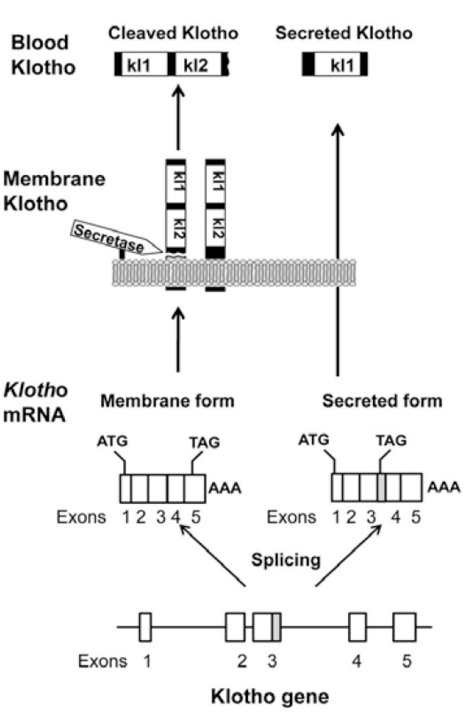
In Figure 1 below, the different forms of alpha-Klotho can be seen. Secreted Klotho derives due to alternative RNA splicing. The spliced transcript contains 50 bp insertion after exon 3 (grey). The cleaved Klotho contains kI1 and kl2 repeats, which is shed and cleaved by α and β-secretases, and released into blood stream. The secreted Klotho however contains only kl1 and is released into the blood as well.[4]
Conclusion
In blood circulation, two forms of Klotho are present, one is derived from cleavage of the extracellular domain of membrane Klotho and another one is secreted by the membrane and derived from an alternatively spliced Klotho transcript.[4] The different functions of these forms are the focus of future studies.
Manufactured by IBL-Japan (Original Ref. Nr. #27901), distributed by Tecan, IBL International GmbH.