α-Klotho, named after the Greek Goddess of Fate, Clotho, who spins the thread of life, was originally characterized as an aging suppressor gene. Our ELISA is perfectly suited for the measurement of the product of this gene - the α-Klotho protein. α-Klotho is also known as the messenger of healthy bodies (Fantuzzi G Front Immunol. 2014 Jul 21;5:351).
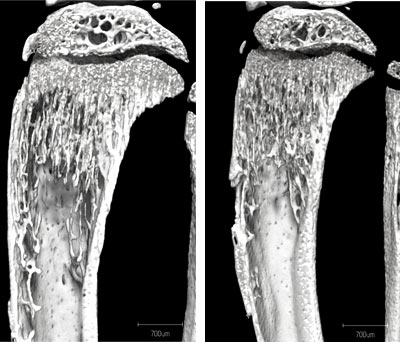
A defect in klotho gene expression in the mouse results in a syndrome that resembles human ageing, including a short lifespan, infertility, arteriosclerosis, skin atrophy, osteoporosis and emphysema. The absence of α-Klotho leads to a substantially lower bone density than usual (Kuro-o M et al. Nature. 1997 Nov 6;390(6655):45-51).
Picture: α-Klotho deficiency leads to bone mass density loss as the comparison of wildtype (left) and α-Klotho knockout mice (right) demonstrates (picture kindly provided by Dr. Yoichi Nabeshima, Laboratory of Molecular Science, Institute of Biomedical Research and Innovation, Foundation for Biomedical Research and Innovation, Kobe, Japan)
Since the discovery of α-Klotho, which was described in the publication mentioned above, several research areas have emerged which benefit from the determination of α-Klotho in terms of gaining valuable additional information:
Bone metabolism
Aging processes/longevity
Nephrology
Immunology, etc.
α-Klotho in the light of bone metabolism
α-Klotho and FGF23 are the main mediators of calcium and phosphate homeostasis. Any kind of disturbance in this regard, such as a reduced or increased production of α-Klotho, leads to metabolic bone disorders (John GB et al. Am J Kidney Dis. 2011 Jul;58(1):127-34).
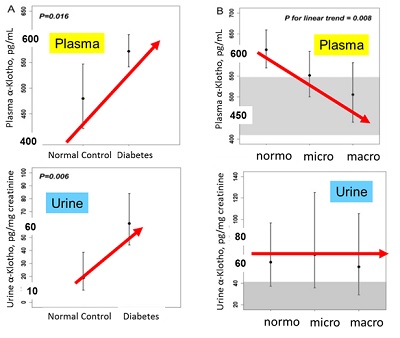
The outcomes of research in the areas of bone metabolism and aging, as well as the fact that α-Klotho is produced exclusively in the kidneys and brain, have prompted investigations into the impact of changes in α-Klotho levels in renal disease. Studies have revealed that α-klotho levels are significantly decreased in the serum already at an early stage in chronic kidney disease (Pavik I et al. Nephrol Dial Transplant. 2013 Feb;28(2):352-9). Since chronic kidney disease frequently occurs secondary to other medical conditions, α-Klotho is receiving increasing attention as a marker of the occurrence of chronic kidney disease in primary diseases such as type 2 diabetes (Lee EY et al PLoS One. 2014 Aug 1;9(8):e102984), whereby the sample material should be noted (see image below).
Figure 1: In type 2 diabetes patients with stable renal function, both plasma and urine α-Klotho levels are significantly increased compared to healthy controls. With decreasing renal function, shown as albuminuria, α-Klotho levels decrease in plasma while remaining stable in urine.
α-Klotho in the context of longevity
Several studies have shown that elevated α-Klotho levels can be linked to improved cognitive and brain resilience. People with higher levels have been shown to be less prone to any type of brain damage, including infections and neurodegenerative diseases.
Recent research from the FIT-AGEING study in Spain shows that engaging in moderate physical activity is the most effective way to boost alpha-Klotho. In contrast, both a sedentary lifestyle and excessive exercise fail to deliver the same benefits. This insight helps to make informed choices that truly impact long-term health.
α-Klotho is a biomarker of interest in research related to aging biology and cellular processes. Widely used in aging and longevity research, the IBL-Japan α-Klotho ELISA is a well-established assay, cited in over 400 publications for soluble α-Klotho measurement.
Separate control set available on request
Distributed by TECAN, IBL International
For concrete data please consult the Instruction for Use in the download box on the top right side.
Kuriyama N, Ozaki E, Mizuno T, Ihara M, Mizuno S, Koyama T, Matsui D, Watanabe I, Akazawa K, Takeda K, Takada A, Inaba M, Yamada S, Motoyama K, Takeshita W, Iwai K, Hashiguchi K, Kobayashi D, Kondo M, Tamura A, Yamada K, Nakagawa M, Watanabe Y. Association between α-Klotho and Deep White Matter Lesions in the Brain: A Pilot Case Control Study Using Brain MRI. J Alzheimers Dis. 2018;61(1):145-155. PubMed ID: 29154273 keywords: blood alpha-klotho, cerebral DWML, useful clinical index of vascular cognitive impairment
Tan SJ, Smith ER, Holt SG, Hewitson TD, Toussaint ND. Soluble klotho may be a marker of phosphate reabsorption. Clin Kidney J. 2017 Jun;10(3):397-404. PubMed ID:28616218 keywords: chronic kidney disease, CKD, phosphate reabsorption, soluble klotho, urinary phosphate excretion, serum
Our comprehensive immunoassay portfolio includes a number of specialty diagnostic immunoassays for endocrinology, immunology and autoimmunity, as well as for diagnosis of multiple infectious diseases. We are pioneers and market leaders in saliva diagnostics, with over 40 years of experience supplying a broad portfolio of luminescence- and ELISA-based tests, including our highly acclaimed HMGB1 and MuSK-Ab ELISAs.
And as experts in laboratory automation, we can support our customers with the protocols for open ELISA platforms, such as the Freedom EVOlyzer or Thunderbolt®.
All products are only available for sale to laboratory professionals and may not be available in all countries. Availability and regulatory status may vary across regions depending on local country-specific registration. Please always read and follow the instructions for use.
All of our assays have been designed and manufactured to meet the highest global regulatory requirements and quality standards. Tecan is certified under ISO 9001:2015, ISO 13485:2016 and is audited by a notified body according to Medical Device Single Audit Program (MDSAP).
This is who we are.
As part of the Tecan Group, we have a leading market position in diagnostics and research, with over 40 years of experience in the development, manufacture and supply of enzyme-, radiolabel- and luminescence-based immunoassays.
Our range of high-quality immunoassays is supported by a diverse portfolio of automated solutions, making us the perfect partner for you and your customers.