



Offline mode

Brain-Derived Tau (BD-Tau) Luminescence Immunoassay

Buy on the e-shop
Catalog no.30260913
Regulatory Status
RUO
Kit size
12 x 8
Method
Luminescence Immunoassay
Incubation time
1 x 3h
Standard range
1 - 100 pg/mL
Specimen / Volumes
50 µL plasma, serum, diluted eluate
Substrate / isotope
Luminol
instructions for use

Brain-derived Tau detection – made simple in blood.

The Brain-derived Tau (BD-Tau) LUM is a sensitive and accessible research-use only blood assay. Combining a specific antibody targeting brain-derived Tau with upfront immunoprecipitation, BD-Tau LUM offers researchers a powerful and accessible tool to investigate Alzheimer's disease pathology, progression, and biomarker dynamics in plasma.

Request your trial kit now!

The Human BD Tau Luminescence Immunoassay is an enzyme immunoassay intended for the quantitative determination of brain derived TAU protein from peripheral cell free body fluids as blood plasma or serum after enrichment of BD Tau using the BD-Tau Neuro IP Kit (30260912).

Summary

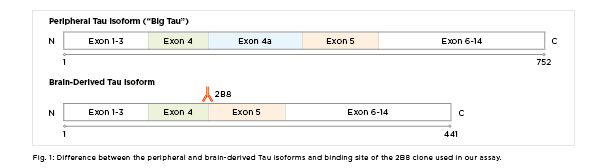
The Tau protein is a microtubule-stabilizing protein being part of the axons of nerve cells in the central nervous system (CNS). Measuring total Tau in CSF reflects axonal destruction and has found its way into diagnostic criteria guidelines¹, but measuring total Tau in blood does not correlate with its corresponding CSF value. As 80% of Tau in blood originates from peripheral tissue, being able to selectively measure the brain-derived fraction will enhance specificity and accessibility of Tau as an AD biomarker. The antibody used in the BD-Tau LUM is targeting the brain-derived Tau isoform only.

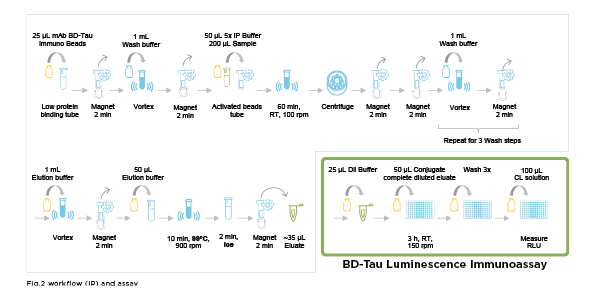
The analysis of brain-derived Tau is coupled with a pre-analytical immunoprecipation (IP) step to enhance better detection in the later assay.

Values of measuring BD-Tau

  • Detection of brain-specific Tau fractions
  • BD-Tau provides a more specific signal of neurodegeneration compared to total Tau measured in plasma²
  • Measurement of BD-Tau in blood samples correlates well to total Tau measurements in CSF³
  • Enables longitudinal assessment of biomarker level changes related to Alzheimer’s disease⁴
  • Reflects disease severity and progression trends supporting biomarker discovery and validation⁴
  • Complementary to measuring Amyloid-beta 1-42 and pTau217 in plasma helping to stratify participants based on recommendation of anti-amyloid treatment studies⁴

Using an assay to detect BD-Tau in blood samples provides a low-invasive research tool to help screen and stratify participants for different kinds of studies.

Distributed by TECAN, IBL international

For concrete data please consult the Instruction for Use in the download box on the top right side.

  1. Jack, C. R., Jr, Andrews, S. J., Beach, T. G., Buracchio, T., Dunn, B., Graf, A., Hansson, O., Ho, C., Jagust, W., McDade, E., Molinuevo, J. L., Okonkwo, O. C., Pani, L., Rafii, M. S., Scheltens, P., Siemers, E., Snyder, H. M., Sperling, R., Teunissen, C. E., & Carrillo, M. C. (2024). Revised criteria for the diagnosis and staging of Alzheimer's disease. Nature medicine, 30(8), 2121–2124. https://doi.org/10.1038/s41591-024-02988-7
  2. Gonzalez-Ortiz, F., Turton, M., Kac, P. R., Smirnov, D., Premi, E., Ghidoni, R., Benussi, L., Cantoni, V., Saraceno, C., Rivolta, J., Ashton, N. J., Borroni, B., Galasko, D., Harrison, P., Zetterberg, H., Blennow, K., & Karikari, T. K. (2023). Brain-derived tau: a novel blood-based biomarker for Alzheimer's disease-type neurodegeneration. Brain : a journal of neurology146(3), 1152–1165. https://doi.org/10.1093/brain/awac407
  3. Gonzalez-Ortiz, F., Dias, A., Turton, M., Magalhães, R., Kac, P. R., Correia, M., Harrison, P., Zetterberg, H., Maia, L. F., Blennow, K., & Karikari, T. K. (2023). Preanalytical stability of plasma/serum brain-derived tau. Alzheimer's & dementia : the journal of the Alzheimer's Association19(10), 4764–4770. https://doi.org/10.1002/alz.13156
  4. Gonzalez-Ortiz, F., Kirsebom, B. E., Contador, J., Tanley, J. E., Selnes, P., Gísladóttir, B., Pålhaugen, L., Suhr Hemminghyth, M., Jarholm, J., Skogseth, R., Bråthen, G., Grøndtvedt, G., Bjørnerud, A., Tecelao, S., Waterloo, K., Aarsland, D., Fernández-Lebrero, A., García-Escobar, G., Navalpotro-Gómez, I., Turton, M., … Blennow, K. (2024). Plasma brain-derived tau is an amyloid-associated neurodegeneration biomarker in Alzheimer's disease. Nature communications15(1), 2908. https://doi.org/10.1038/s41467-024-47286-5

Our Product Families

Our comprehensive immunoassay portfolio includes a number of specialty diagnostic immunoassays for endocrinology, immunology and autoimmunity, as well as for diagnosis of multiple infectious diseases. We are pioneers and market leaders in saliva diagnostics, with over 40 years of experience supplying a broad portfolio of luminescence- and ELISA-based tests, including our highly acclaimed HMGB1 and MuSK-Ab ELISAs.

And as experts in laboratory automation, we can support our customers with the protocols for open ELISA platforms, such as the Freedom EVOlyzer or Thunderbolt®.

All products are only available for sale to laboratory professionals and may not be available in all countries. Availability and regulatory status may vary across regions depending on local country-specific registration. Please always read and follow the instructions for use. 

All of our assays have been designed and manufactured to meet the highest global regulatory requirements and quality standards. Tecan is certified under ISO 9001:2015, ISO 13485:2016 and is audited by a notified body according to Medical Device Single Audit Program (MDSAP).

Image on background

This is who we are.

As part of the Tecan Group, we have a leading market position in diagnostics and research, with over 40 years of experience in the development, manufacture and supply of enzyme-, radiolabel- and luminescence-based immunoassays.

Our range of high-quality immunoassays is supported by a diverse portfolio of automated solutions, making us the perfect partner for you and your customers.

Happy to help.

At Tecan, we are driven to improve people’s lives and health.